
Hours and entry fees at each site (INAH, 2026)
INAH, Mexico's National Institute of Anthropology and History, is the federal agency that runs these sites, and hours and fees below come from its official listings. Distances are by road from downtown Bacalar. Fees are in pesos, with the Mexican rate first and the foreign-visitor rate second; at about 18 pesos to the dollar, foreigners pay roughly US$8 to US$12.
| Site | From Bacalar | Hours | Entry |
|---|---|---|---|
| Ichkabal | 25 mi (40 km) | 8 a.m.–5 p.m. (last entry 4:00) | Free in 2026 |
| Chacchoben | 31 mi (50 km) | 9 a.m.–3 p.m. (last entry 2:30) | $85 / $155 |
| Oxtankah | 33 mi (53 km) | 9 a.m.–5 p.m. | $80 / $145 |
| Kohunlich | 42 mi (68 km) | 8 a.m.–5 p.m. (last entry 4:30) | $105 / $210 |
| Dzibanché and Kinichná | 51 mi (82 km) | 8 a.m.–5 p.m. (last entry 4:30) | $85 / $155 |
No food, pets or smoking at any of them, and professional cameras pay an extra fee. Get to Oxtankah before 3 p.m.: its listing says it closes at 5, but the INAH bulletin for its 2024 reopening said 3. To double-check, the INAH office in Quintana Roo answers at +52 983 837 2411.
Chacchoben: the second-busiest site in the state
Chacchoben means "place of the red corn." People lived here from about 200 BC; it was abandoned in the Late Classic and used again in the Postclassic, until around AD 1450, as a pilgrimage site. The main stops: the Gran Basamento, the ceremonial core, with two pillars known as "the Twins"; Temple 24, a stepped pyramid; the Temple of the Vessels, named for the pottery found inside; and the Conjunto de las Vías, a group of low platforms.
From January to April 2025 it drew 100,768 visitors, second only to Tulum in Quintana Roo, according to INAH figures. Many of them come on shore excursions from the Costa Maya cruise port. If you're driving yourself, walk in at 9 a.m. when it opens; last entry is 2:30 p.m.
From Bacalar, take Highway 307 north. The turnoff is at the village of Lázaro Cárdenas, and from there it's 9 km (6 miles) to the site, per the INAH listing.
Dzibanché and Kinichná: the first capital of the Snake Kingdom
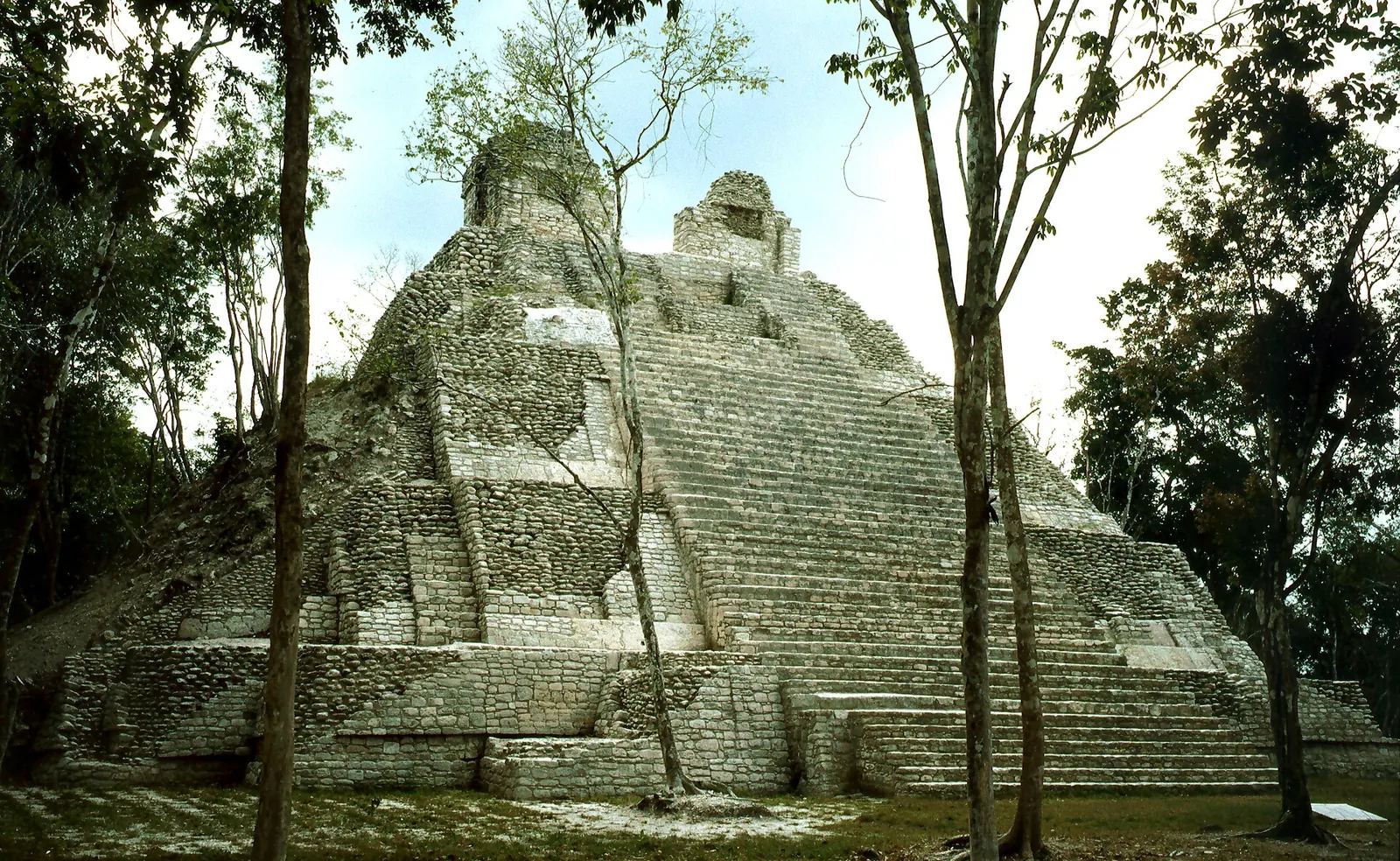
Dzibanché was the first capital of the Kaan dynasty, the "Snake Kingdom": its ancient name, Kaanu'l, means "place of snakes." In the late 6th or early 7th century the dynasty moved its seat to Calakmul. The modern name was coined by explorer Thomas Gann in 1927 and means "writing on wood," after the carved wooden lintels in the Temple of the Lintels.
The trail takes you through Xibalba Plaza, home of the Temple of the Owl, where archaeologists found the tomb of a high-ranking woman dating to around AD 400, and past the Temple of the Cormorants, the largest pyramid in the Main Group. Kinichná is 2 km (1.2 miles) north, its acropolis topped by a three-temple pyramid about 35 m (115 ft) high. Both sit on the road out of the village of Morocoy, at km 14 and km 16, so you drive from one to the other.
INAH reopened the site in February 2025 with a new ticket office, restrooms, parking and trails. During that work, in October 2024, crews uncovered three facades with stucco reliefs. It's the farthest site on the list, at 51 miles (82 km).
Oxtankah: the Maya port on Chetumal Bay
Don't come to Oxtankah for tall pyramids: this was a city that lived off the water. INAH describes it as a port that controlled what is now Chetumal Bay. Its people traded by canoe out to the Caribbean, made salt and stored rainwater in chultunes, cisterns cut into the bedrock. It was occupied from about 600 BC to AD 1100 and peaked between 250 and 600.
In Bees Plaza, an altar holds a tomb with a replica of the skeleton, and right there is the site's only surviving stucco mask: a stylized jaguar from the Early Classic. In the middle of the Maya city stands a chapel the Spanish built in the 1500s. Local oral tradition, which INAH cites, says Gonzalo Guerrero lived here in the early 1500s. He was a shipwrecked Spaniard who joined the Maya and died fighting for them.
The site reopened on November 25, 2024, with new trails and a covered rest area. It's 10 miles (16 km) from Chetumal: drive through the bayside village of Calderitas and continue 4.5 km (3 miles) on the paved road along the water. Two hours is enough to see it.
Ichkabal, the closest, and Kohunlich, the one with the masks
Ichkabal opened on January 13, 2025, and charges no entry in 2026; INAH's director in Quintana Roo said a possible fee would be discussed in late 2026. It drew about 38,000 visitors in its first year and is already the fifth most visited site in the state. History, what you'll see and directions: Ichkabal in depth.
Kohunlich is the priciest on the list because INAH ranks it in category I, alongside Tulum and Cobá. People come for the Temple of the Masks, with large stucco faces flanking the stairway. Tour route, history and how to get there: Kohunlich: masks, history and directions.
Two sites in one day: pairings that work
- Kohunlich and Dzibanché. According to INAH, their turnoffs sit at km 58 and km 60 of Highway 186, the road west to Escárcega, which makes them the natural pair. Leave around 7 a.m., and keep in mind last entry at both is 4:30 p.m. The order and drive time between them are on the Kohunlich page.
- Chacchoben and the lagoon. Chacchoben from 9 to 11:30 a.m., then back to Bacalar for lunch and an afternoon boat tour or a swim at one of the lagoon's beach clubs.
- Oxtankah and Chetumal. Oxtankah in the morning, then the afternoon in Chetumal, which is on the way: it's 24 miles (38 km) from Bacalar, and Oxtankah is another 10 miles past it.
Chacchoben and Oxtankah lie in opposite directions, one north on Highway 307 and the other past Chetumal, so pairing them means more than 125 miles (200 km) behind the wheel. To spread ruins, lagoon and town across several days, see the 2- and 3-day itinerary.
Getting there without your own car
No public transportation runs from Bacalar to any of the five sites, and the access roads are long: 9 km (6 miles) off the highway at Chacchoben and Kohunlich, about 14 km (9 miles) at Dzibanché and 23 km (14 miles) at Ichkabal. Getting off a bus at the junction won't get you there. That leaves three options: rent a car, hire a taxi with the round trip and waiting time agreed before you leave, or book a tour. If you compare tours in Bacalar, check what time they reach Chacchoben, since last entry there is 2:30 p.m.
At Ichkabal, Kohunlich and Dzibanché you walk under jungle canopy, and mosquitoes get worse in the rainy season. The dry season, late January to April, is the most comfortable time to go (best time to visit Bacalar). Mahahual, Belize, Calakmul and the nearby lagoons are covered in things to do near Bacalar.