
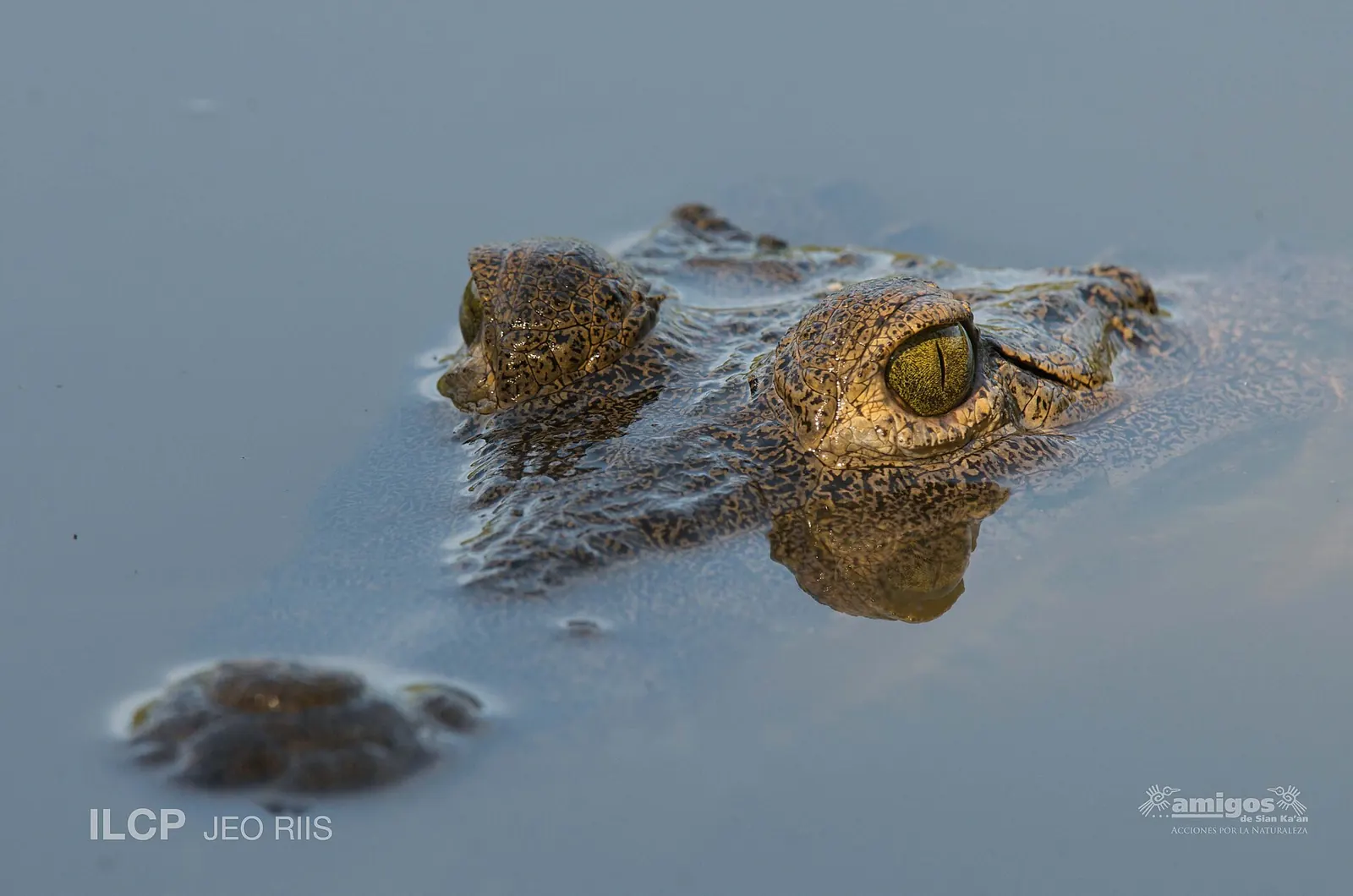
Yes: it's Morelet's crocodile
The species in the lagoon is Morelet's crocodile, also called the swamp crocodile (Crocodylus moreletii). It lives mostly in fresh water, in marshes, swamps, rivers and lagoons, and Bacalar is a freshwater lagoon; the chemistry is in is Bacalar Lagoon freshwater or saltwater.
An average adult is about 7 ft (2.1 m) long; big males reach 10 ft (3 m), and anything larger is very rare. The IUCN lists it as Least Concern, but Mexico's endangered-species standard (NOM-059) classifies it as subject to special protection. Don't bother it or feed it.
Where they've been seen, and how often
There's no published count of the lagoon's crocodiles and no map of where they live. What exists is a handful of news reports, which don't add up to a sighting rate:
| Date | Where | What was reported |
|---|---|---|
| Sept. 2021 | Lagoon shore, on private property | Profepa, Mexico's federal environmental enforcement agency, pulled one out with a fishhook lodged near an eye and took it to the Chetumal zoo (Por Esto) |
| Jan. 2025 | Lagoon, no specific spot | Frequent sightings over the previous weeks worried tour operators and residents (Quintana Roo Hoy) |
| Nov. 2025 | A tourist dock, not named in the story | Tourists and residents reported one (Sol Quintana Roo) |
| Apr. 2026 | Pedro A. Santos, in Bacalar municipality | Someone filmed one on a dirt road next to the Maya Train fence (Por Esto) |
| July 2026 | Pirates' Channel area | Boaters found one floating, dead and headless; environmental authorities are investigating whether people did it (Riviera Maya News) |
The reports have one thing in common: the animals show up at docks and along the shore. Officials and tour operators quoted by Sol Quintana Roo warned that crocodiles can move silently between docks and poorly lit areas. Javier Carballar Osorio, director of IBANQROO, the state's biodiversity and protected areas agency, tied the January 2025 sightings to the unusually wet year of 2024: high water flooded their habitat and pushed them to look for new territory.
Attacks: one reported bite, in 2022
The only reported bite in the lagoon we found was published by The Cancun Sun on March 29, 2022. A man from a Mexico City family had been in the water with his son for about an hour on a Sunday when he was bitten on the left leg; he got out with a deep wound. He said he saw no warning signs. The story doesn't say where in the lagoon it happened, and we found no confirmation from any authority, so treat it as one person's account.
On Chetumal Bay, about 25 mi (40 km) away, there are more cases: a boy of about 9 hurt while fishing in March 2022 (paramedics doubted the wound came from a crocodile) and a dog killed in September 2025. In October 2025, IBANQROO told residents to keep away from the bay's shoreline. That's not Bacalar Lagoon.
We found no report of a person killed by a crocodile in the lagoon. According to IBANQROO, Morelet's crocodiles are wary of people but sometimes mistake them for prey, especially someone splashing at night. The bigger risk, the agency says, is people feeding them, which teaches them to link humans with food.
How to lower the risk
This advice comes from IBANQROO (January 2025) and from the officials and tour operators who spoke up when one showed up at a dock in November 2025:
- Don't swim at night, at dawn or at dusk, when they're most active. IBANQROO even suggested the municipality restrict swimming at those hours.
- Don't feed them, directly or indirectly. If you fish, don't toss scraps in the water.
- Don't leave trash or food scraps on docks and shores.
- Don't get in from isolated shores or unlit docks.
- Ask at the dock or balneario (a swimming spot with a dock and facilities) whether there are recent warnings. In 2025 IBANQROO called for more signs where crocodiles are seen, the same signs that were missing in 2022.
If you're kayaking or paddleboarding, go out in daylight and be back before dark. After a night out in town, save the swim for the morning.
If you see one
Profepa gave this advice during crocodile sightings in Puerto Vallarta in July 2026, and it applies here too: stay calm, back away slowly, don't throw anything at it and report it to 911. Don't touch it or move in for a photo; only trained staff should handle it. 911 is also the number if someone is hurt, same as in the US and Canada. Other safety notes for the area are in is Bacalar safe?.
The 2025 sightings followed an unusually wet year, so check for new notices from IBANQROO or the municipality before your trip.