
What "Bacalar" means
The name is Maya. The municipal profile records the old name as Siyan Ka'an Bakjalal: Siyan Ka'an translates as "birthplace of the sky" and bak jalal as "fenced in" or "surrounded by reeds," the cane-like plant that grows along the shore. Put together, the usual translation is "where the sky is born, surrounded by reeds." You'll also see it spelled Sian Ka'an Bakhalal.
Don't confuse it with Sian Ka'an, the biosphere reserve south of Tulum. They share the words, not the place.
Before the Spanish
Before the conquest, the peninsula was split into Maya provinces. The municipal profile names Bakhalal as the seat of one of them, Uaymil, and as a trading post with Central America, especially the Ulúa region of present-day Honduras. The same source dates the town's founding to around AD 435; Wikipedia says 415.
A few miles from town is Ichkabal, one of the area's Maya archaeological sites, which appears on the municipal coat of arms.
Salamanca de Bacalar, the Spanish town
According to INAH, Mexico's national institute of anthropology and history, the Spanish founded Bacalar in 1544, in a region of swamps, jungle and mangroves chosen largely for the lagoon. They called it Villa de Salamanca de Bacalar; other sources give 1545 or 1546 and credit Gaspar Pacheco. The town lived off timber and logwood, a natural dye prized in Europe.
Pirates and abandonment
The municipal profile records the first major raid in 1642: a privateer known as Diego "el Mulato" arrived with about 70 men and looted the town. Raids by pirates and smugglers operating out of Belize continued for decades. By 1696, according to INAH, the town had been abandoned because of harsh living conditions and those attacks. The Pirates' Channel on the lagoon takes its name from that era.
San Felipe Fort
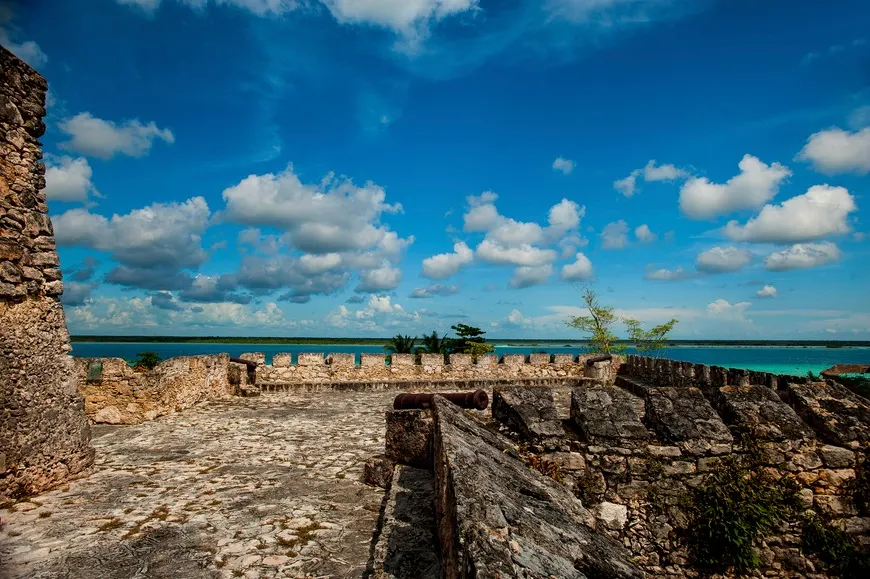
Between 1727 and 1729, the governor of Yucatán, Antonio de Figueroa y Silva, pushed to resettle Bacalar and included a fort to assert the Spanish Crown against the English in Belize. INAH says the first fortification was described in 1729 as a square about 25 m (82 ft) per side, with four corner bastions and a moat. A raised gun platform and stone houses for soldiers came later. Many sources give 1733 as the completion date.
The fort went on to serve as barracks and a hospital, then sat abandoned. It reopened as a museum in 1983 and is now the Museo del Fuerte de Bacalar, run by the state government. Hours and what to see are in San Felipe Fort.
The Caste War (1847 to 1901)
The Caste War was a Maya uprising against the ruling Yucatecan elite that lasted more than half a century. In 1846, before it began, Bacalar had 6,078 residents, a church and a customs house, according to INAH. Maya rebels occupied the town in May 1848; in 1849 a force under Colonel José Dolores Cetina landed from the port of Sisal and took it back.
On February 20, 1858, the Cruzob, the rebel Maya of the eastern peninsula, stormed Bacalar and killed nearly the entire garrison and civilian population. From then on it stopped being a town and served as a depot for weapons and supplies arriving from Belize.
Under President Porfirio Díaz, after Mexico and Britain settled the Belize border (the Spencer-Mariscal treaty), the federal army pushed into Cruzob territory. On March 31, 1901, troops under General José María de la Vega occupied Bacalar. By 1903 it had just 207 residents.
From village to Pueblo Mágico and municipality
Bacalar was resettled over the 20th century. In 2006 it joined Pueblos Mágicos, a federal program that recognizes towns for their history and character, as the first in Quintana Roo, ahead of Isla Mujeres and Tulum (2015) and Cozumel (2023). In 2007, while still part of Othón P. Blanco, it was granted city status.
On February 2, 2011, Quintana Roo's congress voted to create the municipality of Bacalar, carved out of Othón P. Blanco, and the decree was published on February 17. It was the state's tenth municipality. It covers 7,161.5 km² (about 2,765 square miles) and 83 communities, per the municipal profile, and had 41,754 residents in the 2020 census. About 20.9% of residents aged 3 and over speak an Indigenous language, mostly Maya.
Bacalar's coat of arms
The municipal profile describes the coat of arms this way:
- The lettering is inspired by the pirate raids.
- The ruins of Ichkabal stand for the pre-Hispanic past.
- San Felipe Fort stands for the conquest and colonial era.
- The lagoon and a snail stand for nature; the snail as a key species in the ecosystem.
- A 10-pointed sun stands for the 10 municipalities Quintana Roo had when Bacalar's was created. The state has 11 today.
Mennonites in the Bacalar municipality
Since the 2000s, Mennonite colonies have settled on community-owned lands in the municipality, such as Salamanca, the largest, and El Bajío. They're farming communities that have expanded onto former jungle, which has put them at the center of deforestation complaints; Mexico's environmental enforcement agency, Profepa, has halted clearing on Mennonite-held land in southern Quintana Roo. Note that this Salamanca is a modern farming community, not the colonial Salamanca de Bacalar.
Where to see this history today
- San Felipe Fort and its museum.
- Downtown Bacalar, with the main square and the church of San Joaquín, the town's patron saint.
- The San Joaquín Fair every August (dates in the events calendar).
- The Pirates' Channel, on a lagoon tour.
- Ichkabal and other Mayan ruins near Bacalar.
To plan your visit, continue with the Bacalar travel guide or Bacalar Lagoon.