
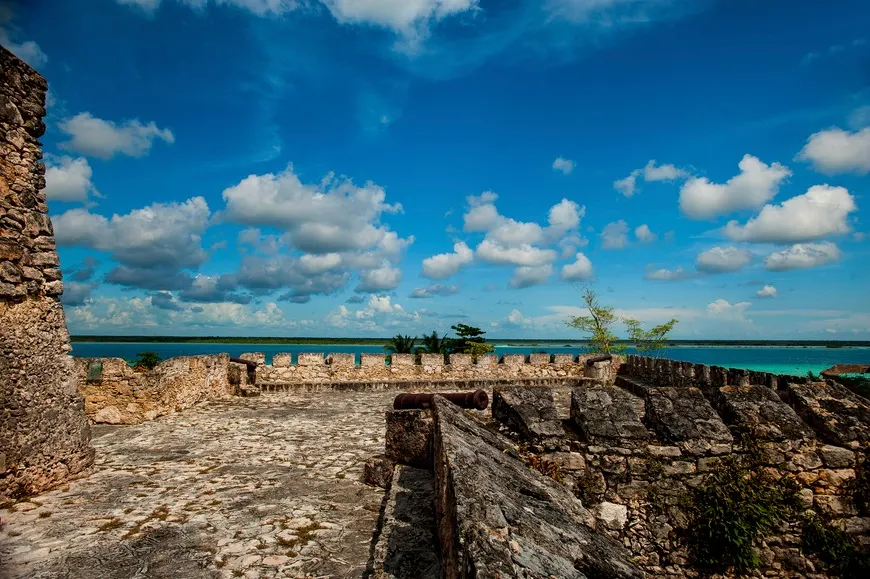
Where it is: downtown, next to the main square
The fort sits on a small rise in downtown Bacalar, beside the zócalo (the main square) and facing the lagoon. The entrance is on Calle 22, between Avenidas 3 and 5. From any downtown hotel you can walk; drivers can usually find a spot on the surrounding streets, though they fill up in high season.
From the park next door you can see the moat and the walls for free. To walk the bastions and see the museum, you need a ticket. What's around it, from the square down to the piers, is covered in downtown Bacalar.
A short history
- Before the fort. For close to two centuries, English, French and Dutch pirates raided Bacalar. They were after logwood, a tree used to dye cloth that was worth a lot in Europe.
- 18th century. The colonial government of Yucatán ordered the fort built; sources date the work from the 1720s to 1733. The design is credited to Italian engineer Juan Podio. It was built of limestone, volcanic rock and coral stone, with four bastions, a moat and a drawbridge, and at its peak held 34 cannons.
- 1858. During the Caste War, a long Maya uprising against the Yucatán government, rebel Maya forces took Bacalar and its fort.
- 1901. Mexican federal troops reoccupied the town, which they found abandoned.
- 20th century. The building was restored, and since 1983, according to most sources, it has been a museum.
The full story of the town, from the Maya settlement of Bakhalal to its designation as a Pueblo Mágico (a federal "magical town" label for places with cultural value), is in Bacalar history.
The pirate museum: what's inside
The museum is run by the Quintana Roo state government through its Institute of Culture and the Arts. Locals call it the Museo de la Piratería (Pirate Museum) or Museo del Fuerte. The rooms are small and go quickly:
- Old maps, ship models, weapons and cannonballs.
- Maya archaeological pieces and everyday objects from the colonial era.
- Rooms on the pirate raids, life in the garrison and the Caste War.
- A mural by Elio Carmichael showing the key moments in the region's history.
Labels are in Spanish and English.
The walls and the lagoon view
Outside the exhibit rooms, the best part is walking the walls and bastions. From the top you see the lagoon's bands of color and the moat, about 4 m (13 ft) deep. Around 11 of the original cannons remain.
In June 2024, heavy rain brought down part of a moat wall, and INAH, the federal agency in charge of Mexico's historic monuments and ruins, began restoring it. Some areas, such as the dungeon and tunnels, may be closed; ask at the ticket booth.
A one-hour visit, in order
- Cross the bridge over the moat and buy your ticket at the booth.
- Walk through the museum rooms: 20 to 30 minutes if you read the main labels.
- Find the Elio Carmichael mural, which sums up the region's history.
- Climb onto the walls and bastions for the view of the lagoon and the town.
- On your way out, stop at the Maya Há craft shop and cross to the main square.
2026 hours and price
| Item | Approximate (2026) |
|---|---|
| Hours | Tuesday to Sunday, 9 a.m.–7 p.m. (closed Monday) |
| Visitors | ≈ $110 MXN (≈ US$6) |
| Locals | ≈ $55 MXN (≈ US$3) |
| Students, teachers and kids | ≈ $30 MXN (≈ US$1.70) |
| Payment | Cash, at the ticket booth |
Fees change and some sources list different figures, so confirm at the gate. Some guides list a 6 p.m. closing, so don't show up after 5:30 p.m.
In 2026 the state government opened the Maya Há craft shop at the fort. It sells work by artisans from 16 Quintana Roo communities directly, with no middlemen: carved wood, woven baskets, embroidery, palm bags and jewelry. It keeps the same hours as the museum.
Tips for your visit
- Go in the morning or mid-afternoon. There's no shade on the walls at midday.
- Wear comfortable shoes. Expect steps, uneven stone and ramps.
- Pair it with downtown. After the museum, walk down to the lakefront road and the free municipal swimming area, or cross to the square for a snack.
- In Bacalar on a Monday? Swap the order: do the lagoon or Cenote Azul and save the fort for another day.
The fort is the town's main cultural stop; for the lagoon and day trips, see things to do in Bacalar.