
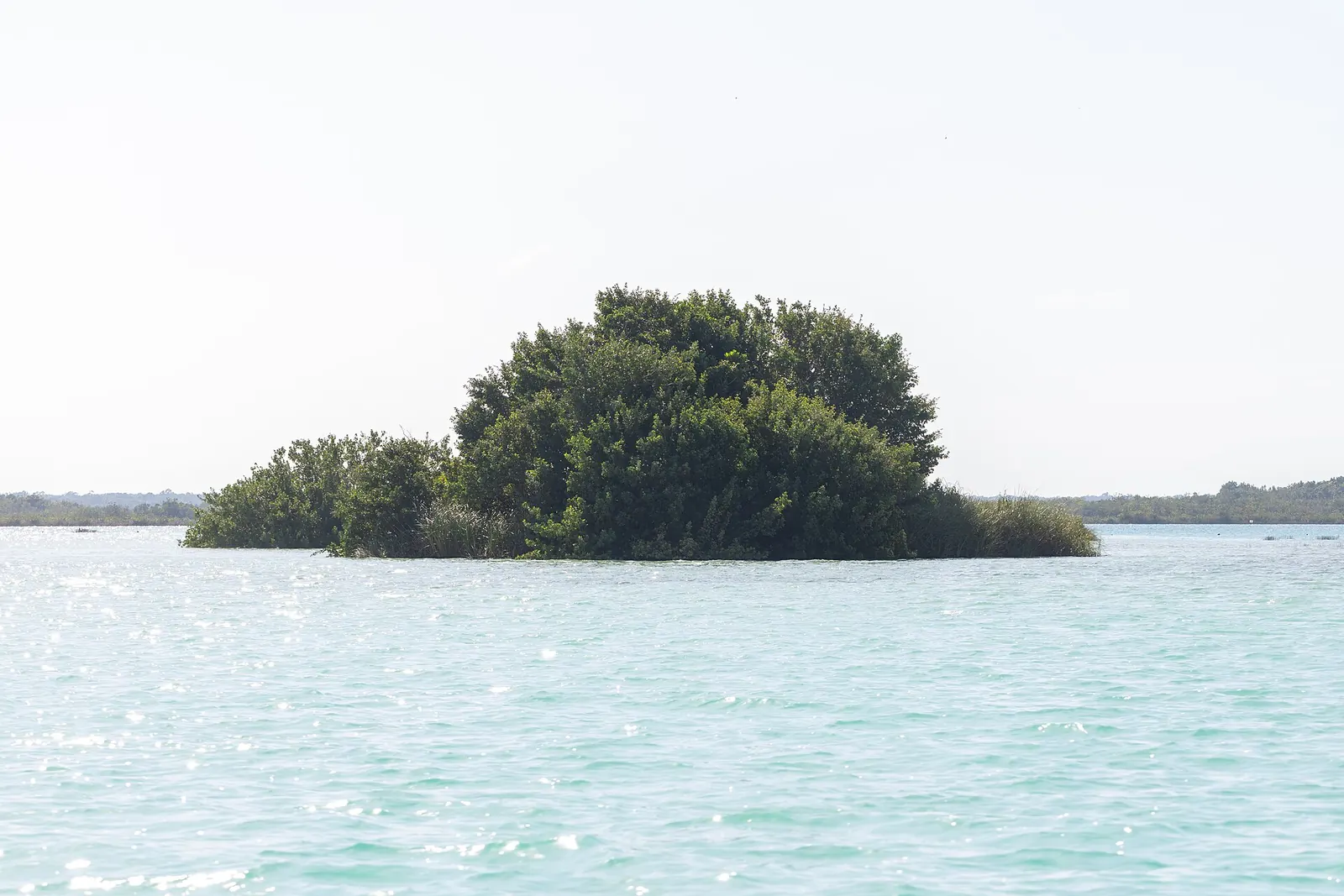
A mangrove islet you watch from the water
Bird Island has no dock, ticket booth or trail. It's a clump of mangrove surrounded by water, where birds roost and nest.
Boat tours fold it into the same loop as Cenote Negro and the Pirates' Channel.
Can you land? No
Buoys, rope and signs ring the island. Local businesses and residents paid for them in April 2018, donating more than 30,000 pesos (roughly US$1,600 at the time), with support from ECOSUR (El Colegio de la Frontera Sur, a public research center). They covered three mangrove islets that locals call the "bird islands."
The 50-meter (165 ft) minimum comes from the boat operators, not from a published regulation. In February 2018, the president of their association said no boat may come closer than that, and that engine noise had at one point badly disrupted nesting.
In September 2025, the Port Captain for Chetumal and Bacalar announced rules that close every buoyed sensitive area to all boats and to swimmers. The announcement doesn't name the island, and in November 2025 the rules still hadn't been published in the DOF, the federal gazette where Mexican regulations become official. If your captain crosses the buoys or offers to let you off, that's breaking the rule, not doing you a favor.
Which birds you'll see: snail kites, limpkins and herons
The best-studied birds on the lagoon are the snail kite and the limpkin. ECOSUR surveyed Bacalar by boat from June 2012 to August 2013, counted 319 snail kites and 339 limpkins, and found both all over the lagoon. Both live almost entirely on chivita (Pomacea flagellata), a freshwater apple snail that people here also gather to eat. The study notes that Mexico's at-risk species list (NOM-059-SEMARNAT-2010) puts the snail kite under special protection and lists the limpkin as threatened.
- Snail kite: a hawk with a deeply hooked bill. Males are slate gray to nearly black, with orange-red legs and a white base to the tail that shows in flight. Females are browner, with white marks on the face and streaked underparts.
- Limpkin: a tall brown wading bird with white spots and a long bill. It grabs a snail in the water and flies to shore to eat it.
There's no published bird count for the island itself. A kayak guide published in February 2025 describes paddling out and finding roseate spoonbills and wood storks roosting in the mangrove, egrets and great blue herons, black vultures overhead and a snail kite near shore. The local paper Por Esto adds herons, parrots, owls and orioles, without saying where that list comes from.
Don't count on seeing nests, either: ECOSUR found no snail kite nests anywhere on the lagoon and only cites an August 2016 report of nesting on an unnamed islet. Bring binoculars; for light and framing, see the Bacalar photo guide.
When to go
Time of day. Por Esto says to go first thing, and the kayak guide starts at sunrise because the water is still and the birds are active. Ask for the day's first departure, or paddle out at sunrise.
Season. Snail kites and limpkins live on the lagoon year-round. ECOSUR's highest counts came in August for kites and in September and October 2012 for limpkins, probably boosted by birds passing through. The kayak guide puts nesting in winter through spring. For weather and crowds, see the best time to visit Bacalar.
Wednesdays. In low season the town halts boat tours that day under its "Respiro a la Laguna" (Give the Lagoon a Break) program, so check before you book.
Three ways to see it
| How | At the island | More |
|---|---|---|
| Motorboat | Usually a slow pass outside the buoys | Boat tour |
| Pontoon | Same loop, between Cenote Negro and the channel | Pontoon tour |
| Kayak or paddleboard | No engine; about half a mile (800 m) from shore, per one guide | Kayak and paddleboard |
When you book, ask whether the tour actually stops off the island or just goes by, and for how long.
Names that get mixed up
- "Pirates' Island": almost always means the Pirates' Channel, which isn't an island.
- "Bacalar Island": Bacalar is the town on the lagoon's shore; no island goes by that name.
- Isla Pájaros near Holbox: a different bird islet in the north of Quintana Roo, with its own rules.
You can also see the stromatolites from the water; to plan the rest of the day, see things to do in Bacalar.