
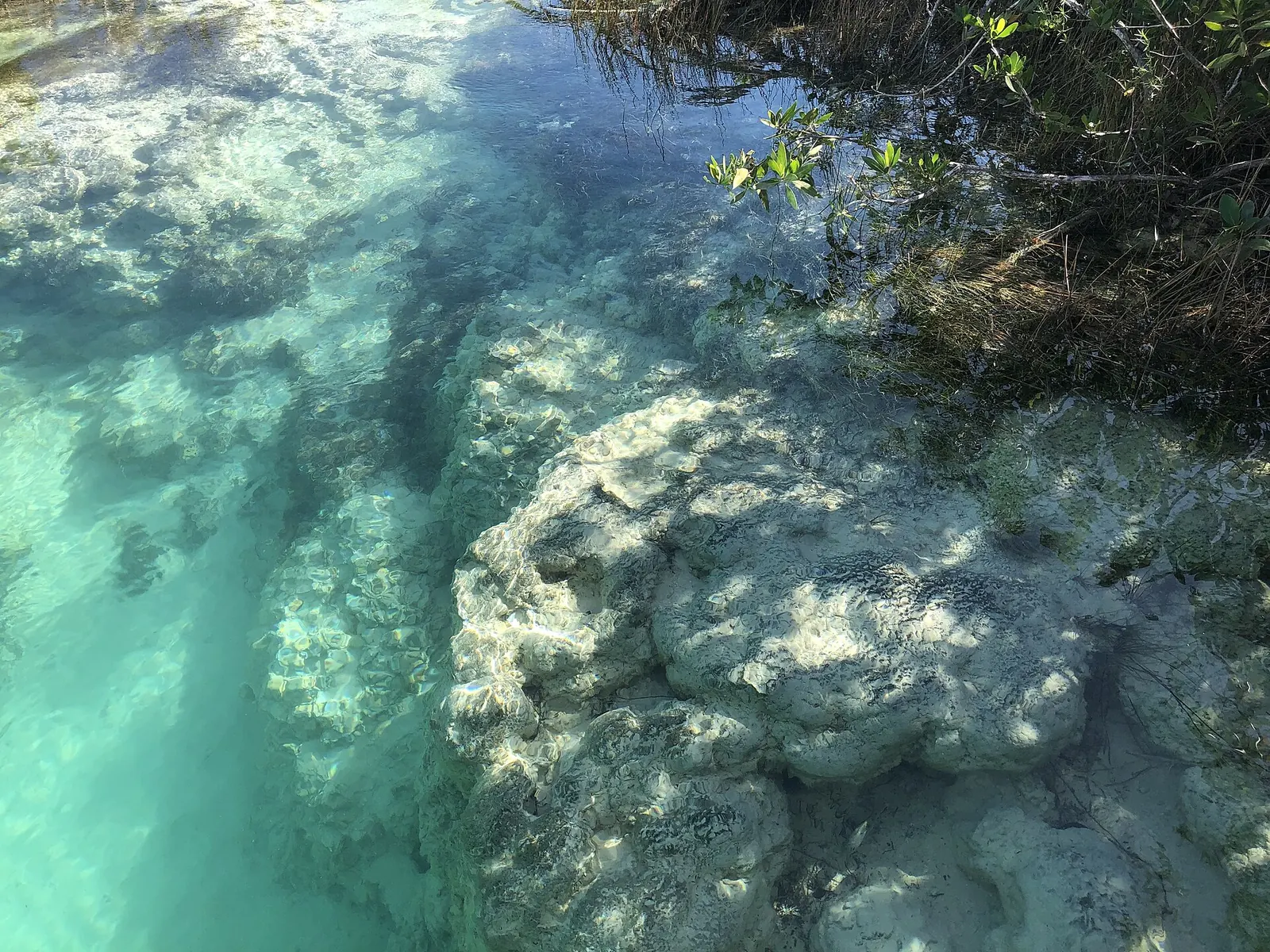
What they are: rocks built by bacteria
A stromatolite is a limestone structure built by communities of microorganisms, mostly cyanobacteria. The bacteria trap particles from the water and precipitate calcium carbonate; that layer hardens, a new living layer grows on top, and the process repeats for centuries. That's why locals call them piedras vivas, "living rocks."
Only the surface is alive: a greenish or brownish film. Underneath is rock left behind by earlier generations. Scientists also call them microbialites.
They grow very slowly. According to researcher Luisa Falcón of UNAM's Institute of Ecology (UNAM is Mexico's national university), Bacalar's stromatolites grow about 1 mm a year. Thousands of microbial species live in each one.
Why they're called one of the oldest life forms
The oldest fossil stromatolites are about 3.5 billion years old. The cyanobacteria that build them were among the first organisms to photosynthesize and release oxygen, and they helped fill Earth's atmosphere with it.
Bacalar's aren't that old: they're modern and still growing. Radiocarbon dating by Gischler, Gibson and Oschmann (2008) shows they began forming about 9,000 to 8,000 years ago. UNAM reports ages ranging from a few decades to more than 9,000 years.
Bacalar: one of the largest freshwater microbial reefs
The study by Gischler and colleagues, published in the journal Sedimentology, measured formations in the lagoon with a combined length of more than 10 km (6 miles), some over 3 m (10 ft) tall, among the largest freshwater occurrences in the world. Specialists at Ecosur, the federal research center based in Chetumal, argue that no other freshwater site holds as many, and note that the first scientific description came out in 1987.
Freshwater stromatolites like these need clear water fed by groundwater and low in nutrients. That's why they're so sensitive to pollution.
Where to see stromatolites in Bacalar
- Los Rápidos. When it operates, the best spot: stromatolites form both edges of the channel, and wooden boardwalks take you to the water without stepping on them. It's closed for now (the reason is below).
- Along the lagoon shore. There are stromatolites at various points, including some swimming spots. Cocalitos, a short drive south of downtown, has a protected stromatolite area. Anywhere you swim, ask where they are and use the dock. Every swimming spot is listed in beach clubs in Bacalar.
- From a boat, kayak or paddleboard. In shallow areas you can see them below the surface. A good operator never anchors or ties up on them. Compare boat tours or rent a kayak or paddleboard.
Why they're so fragile
- They grow 1 mm a year. One footstep or a broken chunk means decades or centuries lost.
- Too many nutrients. Untreated wastewater, fertilizers and deforestation push nitrogen and phosphorus into the lagoon. That feeds algae that cover and crowd out the stromatolites, according to UNAM.
- The water has already changed. In 2020, experts quoted by the newspaper El Universal reported that water quality had declined since 2017–2018 and that the lagoon had lost some of its colors.
- Direct damage. Bacalar's municipal ecology office has documented tourists climbing on them for photos, setting loungers on top, tying boats to them and using the lagoon as a toilet.
- Lotions and clay. The official Mexican Caribbean tourism site lists clay, sunscreen and bug spray washing off swimmers among the biggest threats.
Rules to protect them
- Don't step on, touch, sit on or lean on them.
- Get in and out of the water only by docks, ladders and boardwalks.
- No sunscreen, tanning oil or bug spray in the water. Wear a rash guard and a hat.
- Don't smear the lagoon-bottom clay on your skin or take it with you.
- In a kayak or on a paddleboard, stay off shallow areas and keep your paddle off the banks.
- Never anchor or tie up a boat on them; choose operators who respect the buoys.
- Don't pee in the lagoon, and don't leave trash.
How they're protected today
Bacalar has celebrated Stromatolite Day on July 15 since 2014; each year's events show up in the Bacalar events calendar. In 2020, Semarnat, Mexico's environment ministry, announced it as a national observance and said it was studying a "critical habitat" designation for the stromatolites under the General Wildlife Law, a tool that had never been used in Mexico. Local ejidos (communal landholders) opposed the proposal, and we found no published declaration.
The latest test case is Los Rápidos. In September 2025, ejido members from Xul-Ha asked Profepa, the federal environmental enforcement agency, to investigate sun decks, paths and a large pier they said sat on the channel's stromatolites. In October 2026 Profepa closed the site over that pier, built without an environmental impact permit.
In practice, protection rests on general environmental law, boating rules and local agreements. One concrete measure is Respiro a la Laguna: no tourist boating on Wednesdays. It grew out of a 2020 agreement between the town and tour operators, and in April 2026 it took first place for sustainability at the Premios Mágicos, Mexico's awards for its Pueblos Mágicos. The community has also marked zones with buoys. The most useful thing you can do is follow the rules above and pick operators who do too.
To understand the lagoon as a whole, its colors and why it's freshwater, read Bacalar Lagoon and is Bacalar Lagoon freshwater?. More ideas in things to do in Bacalar.