
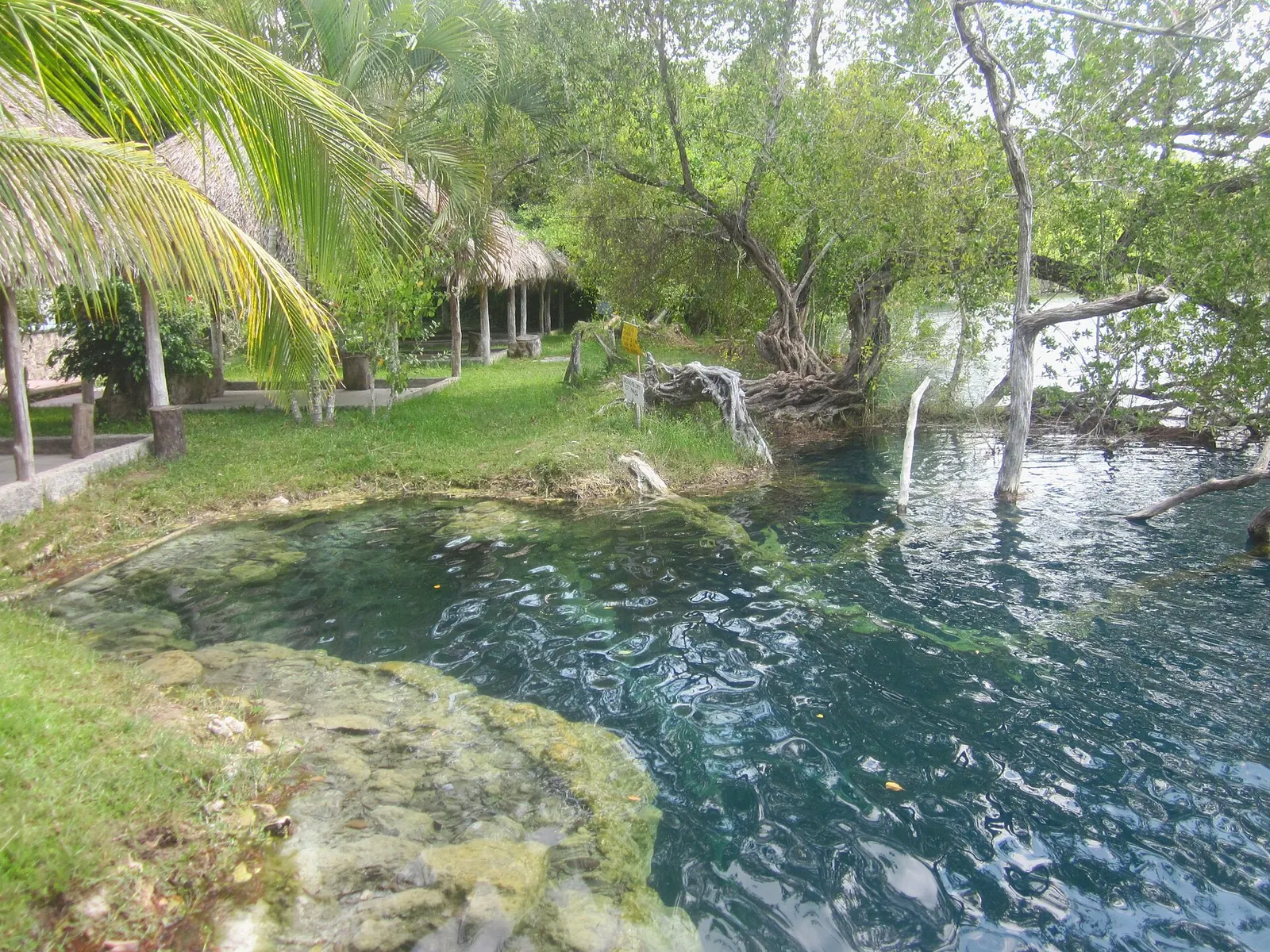
How a cenote ends up inside a lagoon
A cenote is a sinkhole that forms when the roof of an underground limestone cavity caves in. In Bacalar, the lagoon flooded over several of them: unlike the cenotes around Tulum, there are no rock walls or stairs, just holes in the lagoon floor. From a boat you spot them where the turquoise sandbar suddenly ends and the water turns navy blue.
Some are springs, too: Food and Pleasure describes Esmeralda as a spring that feeds the lagoon. Why the water over a cenote looks almost black is on the Black Cenote page; the colors of the rest of the lagoon, on Bacalar Lagoon.
The four side by side
| Cenote | Where | Reported width | Reported depth | How to get there |
|---|---|---|---|---|
| Azul | Outside the lagoon, off Highway 307; ≈ 4 km (2.5 mi) south of downtown | ≈ 200 m (650 ft) | 72–90 m (235–295 ft) | By road, with an entry fee |
| Negro (La Bruja) | In the lagoon, ≈ 1.2 km (0.75 mi) south of downtown | ≈ 130 m (430 ft) | 70–100 m (230–330 ft) | Boat, pontoon or kayak; land access unconfirmed |
| Esmeralda | In the lagoon, ≈ 2.7 km (1.7 mi) south of downtown | 300 to 500+ m (1,000–1,640+ ft) | ≈ 70 m (230 ft) | Boat, pontoon or kayak; by land through a shoreline operator |
| Cocalitos | In the lagoon, inside a swimming park; ≈ 3.5 km (2.2 mi) south | No data | ≈ 60 m (200 ft), one source | By road, with an entry fee; some tours stop |
Distances are in a straight line, from OpenStreetMap coordinates; along the waterfront road they're a bit longer. The sizes come from travel guides that rarely agree, not from an official survey, so treat them as ballpark numbers.
Cenote Azul: the only one outside the lagoon
Separated from the lagoon by land, it sits right off Highway 307. It's the only one of the four with a restaurant, which is also where you pay to get in. Hours, the entry fee, the rules and its real depth are on the Cenote Azul page.
Cenote Negro: the smallest, and closest to town
Also called the Black Cenote, it's the smallest of the three inside the lagoon, about 130 m (430 ft) across, and the nearest to town, off the south end of the waterfront road locals call the Costera. So nearly every boat or pontoon ride includes it, though many just cruise over it. Depth by source, whether you can swim and how to get there are on the Black Cenote page.
Cenote Esmeralda: the biggest in the lagoon
"Esmeralda" means emerald, for the green and turquoise tones in the water. It's the widest cenote in the lagoon: Programa Destinos México puts it at 300 m (about 1,000 ft) across, Thoroughly Travel at more than 500 m (1,640 ft). On depth, three guides agree on roughly 70 m (230 ft).
It lies off the Costera, between Negro and Cocalitos, 1.3 km (0.8 mi) from Cenote Azul. Boat and pontoon tours treat it as an optional stop, so confirm it when you book. Programa Destinos México says a kayak or paddleboard is the best way to circle it; where to rent is on the kayak and paddleboard page.
By land, Thoroughly Travel (September 2026) suggests DayTour Bacalar, an operator on the cenote's edge with boat tours and kayak and paddleboard rentals. We couldn't confirm whether it charges for access or its hours.
Swimming? Sources clash: Thoroughly Travel calls it good for snorkeling, Programa Destinos México warns about the depth, and Food and Pleasure advises against it.
Cenote de la Bruja: another name for Negro
Thoroughly Travel, México Desconocido, Food and Pleasure and the local paper Por Esto! all treat Cenote de la Bruja (Spanish for "the witch's cenote") as another name for Cenote Negro. If you search for "cenote la bruja," that's the spot. If a tour lists both names, ask whether they're really separate stops.
The legend, in two versions
In both, the main character is a woman from the era of the Caste War, the Maya uprising that began in 1847, who is asked to give up her land for a school.
- México Desconocido's version: a healer threw offerings into the cenote and was said to turn into Huay Ix Ke'e'ken, a giant black pig. Before a teachers' college (the Centro Regional de Educación Normal, or CREN) was built, officials asked for her land. She refused, was moved to another part of the lot and left soon after. Some say objects like her offerings still turn up at the site.
- Por Esto!'s version (August 2025): a survivor of that war lived near the cenote in a stone house and strung dolls from the trees around it. When the town tried to evict her to build a school, she cursed anyone who came to her house: they would die or lose their minds. Neighbors started holding rituals, and some claim to have seen a woman floating on the water. A story the same paper ran a day earlier dates the eviction to the 1960s and 1970s.
Neither offers names or dates you can check, and Por Esto! itself notes that not even the witch's existence is proven. What you can verify is less spooky: at the edge, the bottom drops almost straight down from 1.5 m (5 ft) to dozens of meters.
Cocalitos: a cenote on paper, a swimming park in person
Thoroughly Travel gives it about 60 m (200 ft) of depth, but what you find is a private swimming park with an entry fee, swings over the water and a stromatolite colony roped off for protection. Price, hours and what changed after it reopened are on the Cocalitos listing. What those "living rocks" are: stromatolites.
Which one fits your day
- One cenote, on your own: Azul, about 10 minutes from downtown by taxi.
- Several in one morning: a boat tour or a pontoon tour. Both pass Negro; Esmeralda and Cocalitos depend on the operator.
- A swim with restrooms and shade: Cocalitos or Azul.
- Your own pace, no motor: kayak or paddleboard from downtown to Negro, early, before the boats head out. Esmeralda is more than twice as far.
Swimming at the lagoon cenotes
- If your boat stops over a cenote and you're not a strong swimmer, put on a life vest: at the edge, the bottom disappears from one stroke to the next.
- No sunscreen, bug spray or touching stromatolites: those rules apply across the whole lagoon.
- Navigation rules that the Port Captaincy (Capitanía de Puerto) presented in 2025 would ban swimming, snorkeling and diving in cenote caution zones. As of November 2026 we found no sign they've been published in Mexico's federal register (the Diario Oficial), so each operator decides: ask whether a stop is for swimming or just for looking. Details on the Black Cenote page.
More lagoon spots are in things to do in Bacalar.